
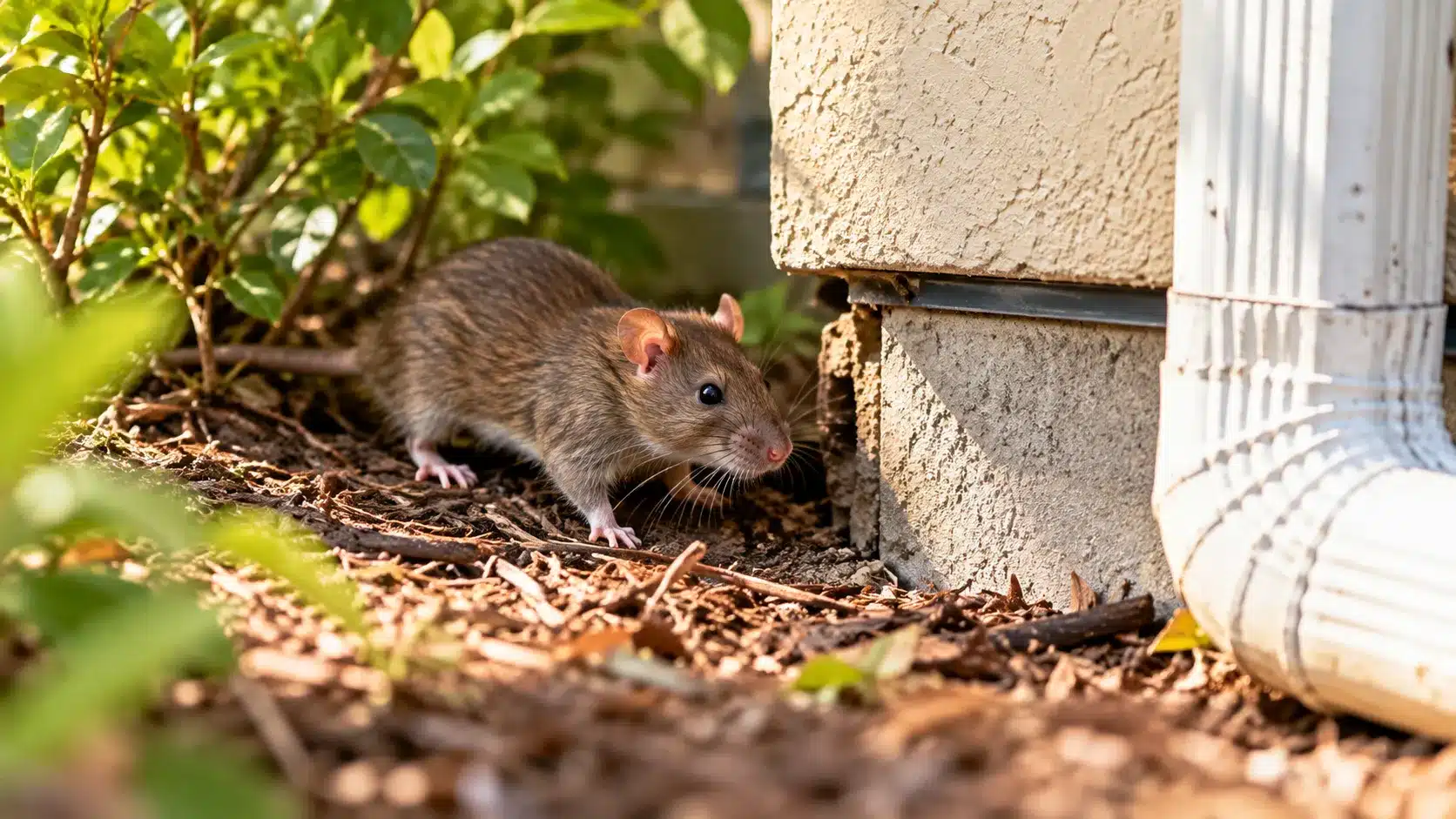
Both rats and mice are common household pests in Southern California. Roof rats are frequently associated with attics, trees and rooflines, while Norway rats are more likely to be found around ground-level areas. House mice can enter through very small openings and are often discovered in kitchens, garages and storage spaces.
Which rodent is more common at a particular home depends on the neighborhood, building and conditions around the property. Without local inspection or trapping data, there isn’t a reliable way to say that rats or mice are more common across every Southern California community.
Knowing the differences can help homeowners recognize what they may be dealing with and understand where to look for activity.
What Types of Rats and Mice Are Found in Southern California?
Three rodents homeowners commonly encounter are roof rats, Norway rats and house mice.
They have different habits, although their activity can overlap.
Roof Rats
Roof rats are good climbers and are commonly associated with trees, fences, overhead utility lines and higher portions of buildings.
They may enter attics through openings near roof vents, eaves or damaged roofline materials.
Roof rats can also feed outdoors, especially where fruit, pet food or other food sources are available.
Norway Rats
Norway rats are generally larger and heavier-bodied than roof rats.
They are more commonly associated with ground-level areas, burrows, foundations, outdoor storage and spaces beneath buildings.
They can enter structures through openings near the ground and may be found around garages, crawl spaces or other protected areas.
House Mice
House mice are much smaller than adult rats.
They can get through very small gaps, which is why UC IPM recommends sealing any hole larger than 1/4 inch. Mice may nest in walls, cabinets, storage areas and other protected spaces.
They often leave small droppings near places where they feed or travel.
How Can You Tell a Roof Rat From a Norway Rat?
The differences are easiest to see when comparing body shape, tail length and where the animal is active.
Roof rats generally have slimmer bodies, pointed noses and tails that are longer than their head and body combined.
Norway rats tend to have heavier bodies, blunter noses and tails that are shorter than their head and body combined.
Location can also provide a clue. Activity high in an attic may suggest roof rats, while burrows near a foundation may suggest Norway rats.
These clues aren’t enough to identify every rodent with certainty.
How Can You Tell a Rat From a Mouse?
Adult rats are usually much larger than house mice, but size alone can be misleading.
A young rat may be small enough to look like a mouse at first glance.
House mice generally have small bodies, relatively large ears and pointed noses. Their droppings are also usually smaller than rat droppings.
If you only find droppings or hear scratching inside a wall, identification may require looking at several signs together.
What Do Rat and Mouse Droppings Look Like?
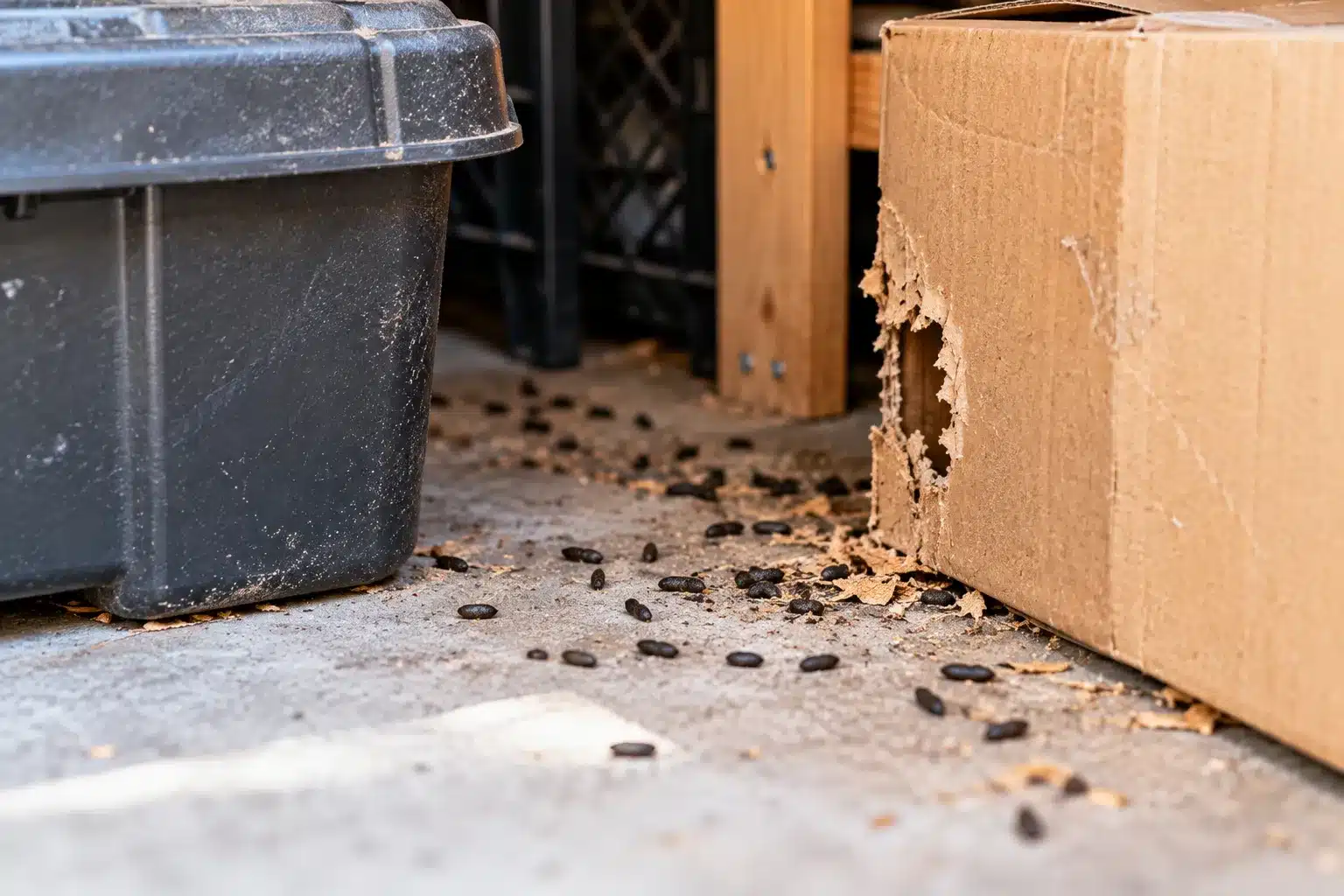
Droppings are often one of the first signs homeowners find.
House mouse droppings are small, with pointed ends.
Roof rat droppings are generally larger and often have pointed ends.
Norway rat droppings are usually larger and may have blunter ends.
The size and shape can help narrow down the possibilities, but they are not enough for a certain identification on their own.
If you find droppings, avoid sweeping or vacuuming them while dry. Follow appropriate rodent-cleanup precautions, especially if there is a large amount of waste or contaminated insulation.
Are Roof Rats More Common in Attics?
Roof rats are well adapted to climbing and are often associated with attic activity in Southern California.
They can use trees, fences and other structures to reach a roof. If they find an opening around a vent, eave or damaged exterior material, they may enter the attic.
Homeowners often notice movement overhead at night before finding droppings or nesting material.
Hearing something in the attic doesn’t always mean it’s a roof rat. Other rodents and wildlife can use roof and attic spaces too.
If you have confirmed rat activity overhead, read How Do You Get Rid of Rats in an Attic in Los Angeles? for more information about inspection, removal and sealing entry points.
Where Do Norway Rats Usually Live?
Norway rats are often found near ground level.
They may dig burrows in soil, particularly around foundations, landscaping, retaining walls or outdoor storage areas.
They also use protected spaces under buildings and around structures where food and water are available.
A homeowner might notice holes in the soil, droppings near a garage or gnaw marks around stored materials.
An inspection can help determine whether the activity is coming from burrows outside or openings that lead into the home.
Where Do House Mice Usually Hide?
House mice can use small spaces throughout a home.
They may nest behind appliances, inside wall voids, around cabinets, in garages or among stored materials.
Because mice are small, openings around utility lines, doors and exterior walls may be enough for them to enter.
Food packaging with small chew marks and droppings in cabinets or pantries can be signs of mouse activity.
Finding those signs repeatedly is a good reason to investigate.
Are Rats More Dangerous Than Mice?
Both rats and mice can contaminate food and surfaces with droppings and urine.
Both can also gnaw on materials around a home, including wiring, packaging and insulation.
The level of concern depends on where the rodents are active, what they’ve contaminated and whether they’ve caused damage.
A rat in the attic may create a different problem from mice repeatedly entering a pantry, but both situations need attention.
If you find droppings or nesting material, avoid disturbing contaminated areas without following proper cleanup precautions.
Do Rats and Mice Make Different Sounds?
Sometimes, but sound alone is not a dependable way to identify the animal.
Both rats and mice may cause scratching, movement or gnawing sounds inside walls and ceilings.
Larger animals can make louder sounds, but building materials, distance and the location of the activity can change what you hear.
The timing and location of the noise are useful clues. Repeated nighttime movement is worth investigating, particularly when there are droppings or other signs nearby.
Can Rats and Mice Live in the Same House?
It’s possible for different rodent species to be present around the same property.
They may use different areas, food sources or travel routes.
Finding droppings of different sizes doesn’t prove that more than one species is present. Age, diet and other factors can affect the evidence.
A technician should look at the full pattern of activity before identifying the rodents involved.
Why Does It Matter Which Rodent You Have?
The type of rodent can help determine where to inspect and how to address the problem.
If roof rats are active, roofline openings, attic vents and climbing routes may deserve particular attention.
If Norway rats are present, ground-level openings, burrows and areas around the foundation may be important.
For house mice, small gaps around doors, utility lines and walls can be especially relevant.
The removal plan and entry-point repairs should match what is found at the property.
Learn more about Touchdown’s rodent control service and how inspections help identify the activity.
What Should You Do If You Find Signs of Rats or Mice?
Start by paying attention to where the evidence appears.
Take photos of droppings, gnaw marks or damaged food packaging before cleaning the area. Make a note of any scratching sounds, including when and where you hear them.
Check accessible areas for food sources such as fallen fruit, pet food or open trash containers.
Avoid handling rodents or disturbing large amounts of droppings without proper precautions.
If the signs keep returning, an inspection can help identify the rodent and determine where it’s getting inside.
Our guide, Rodents in the Attic: The Hidden Damage Homeowners Don’t See, explains the warning signs in more detail.
How Does Touchdown Identify Rodents During an Inspection?
An inspection looks at several kinds of evidence rather than relying on one sign.
A technician may consider droppings, gnaw marks, nesting material, travel routes, entry points and where the activity is occurring.
The goal is to identify the rodent involved, determine whether it is still active and locate the areas that need attention.
Touchdown Pest Control provides rodent inspections and control for homes across greater Los Angeles and Orange County. Based in West Covina, we also offer pest control in the San Gabriel Valley.
We Bring The Blitz!
Frequently Asked Questions
Are roof rats common in Southern California?
Yes. Roof rats are established in Southern California and are often associated with trees, rooflines and attic spaces.
Are Norway rats found in Los Angeles?
Yes. Norway rats are found in the Los Angeles area and are commonly associated with ground-level areas, burrows and spaces around foundations.
Are mice smaller than rats?
Adult house mice are generally much smaller than adult rats. Young rats can sometimes be mistaken for mice, so other physical features and evidence should also be considered.
Can mice get into an attic?
Yes. House mice can enter attics and other protected areas when suitable openings are available.
How can I tell whether droppings are from rats or mice?
Mouse droppings are usually smaller than rat droppings. Shape, size and location can provide clues, but identification is more reliable when combined with other evidence.
Should I trap rats or mice myself?
Homeowners may be able to address limited activity with appropriate traps, but recurring activity, inaccessible nesting areas or multiple entry points may require professional inspection and removal.