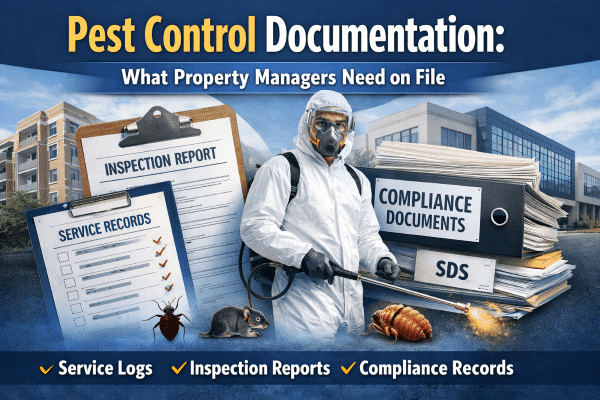
Pest Control Documentation: What Property Managers Need on File
Managing rental housing, HOAs, apartment communities, or commercial buildings means you’re responsible for more than repairs and rent collection. You’re responsible for health, liability, and compliance, and that’s where pest control documentation becomes critical.
Too many property managers only think about pest control when tenants complain. But inspectors, insurers, and legal disputes don’t care whether you treated the problem; they care whether you can prove you managed it properly. Without the right paperwork, even a minor pest issue can become a legal, financial, or reputational nightmare.
This guide explains exactly what documentation you must maintain, why it matters, and how proper record-keeping protects your property, tenants, and business.
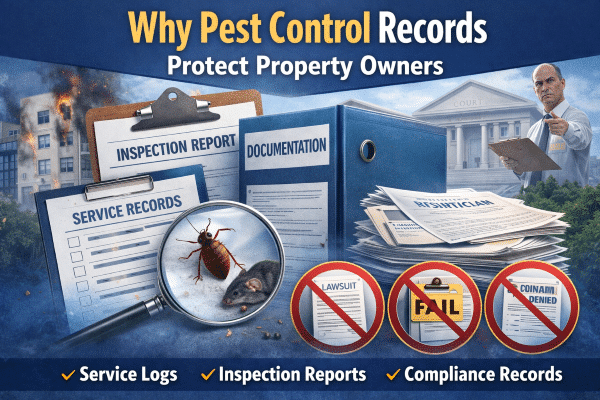
Why Pest Control Records Protect Property Owners
Good pest control is invisible. Good documentation is protection.
Property managers operate in a risk-heavy environment. One complaint about cockroaches, rodents, or bed bugs can trigger inspections, tenant disputes, rent withholding, or even lawsuits. Documentation shows that you acted responsibly and followed professional standards.
Service Logs: Your First Line of Legal Defense
Every service visit must generate a written record. A service log proves your property is under active management, not neglect.
A proper log should include:
- Date and time of service
- Areas treated
- Target pests
- Treatment methods used
- Technician identification
- Follow-up schedule
Why this matters:
If a tenant claims negligence, the first question asked is “Did management take reasonable action?”
Service logs answer that immediately.
Without pest control documentation, a tenant complaint becomes your word against theirs.
With documentation, it becomes a closed case.
Inspection Reports: Evidence of Prevention, Not Reaction
A major mistake property managers make is only documenting treatments, not inspections.
Inspections show prevention. And prevention shows responsibility.
A complete inspection report records:
- Activity levels (none, low, moderate, heavy)
- Conducive conditions (trash storage, moisture, gaps)
- Structural vulnerabilities
- Tenant sanitation concerns
- Recommendations for correction
These reports prove you were actively monitoring the property instead of ignoring developing issues.
If a health department or housing authority gets involved, inspection records demonstrate proactive management, often preventing fines entirely.
Compliance Paperwork: Required for Multi-Unit and Commercial Properties
For HOAs and commercial landlords, compliance isn’t optional.
Many municipalities, insurance policies, and lease agreements require documented pest management programs. Missing paperwork can invalidate coverage after a claim.
Typical compliance records include:
- Chemical usage reports
- Safety Data Sheets (SDS)
- Technician licenses
- Treatment notification postings
- Integrated Pest Management (IPM) plans
Property managers who keep these organized rarely face penalties.
Those who don’t often face the harshest enforcement actions.
Professional providers like Touch Down Pest Control automatically maintain these records and provide them upon request, which is one of the biggest advantages of professional service over informal treatments.
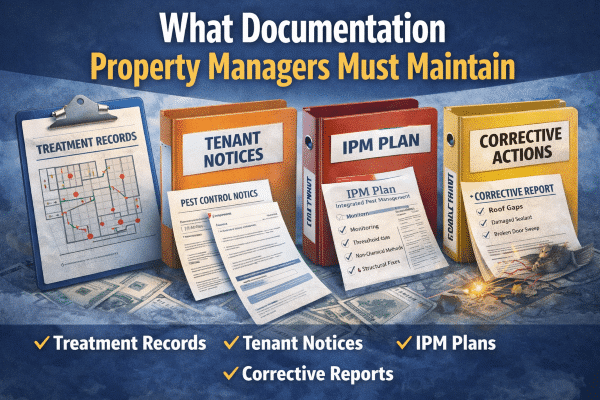
What Documentation Property Managers Must Maintain
Not all paperwork is equal. Some documents are helpful, others are essential.
Here’s what should always be on file.
Treatment Records (Every Visit, No Exceptions)
This is the backbone of pest control documentation.
A treatment record should clearly answer:
What was done, where, why, and by whom?
Include:
- Treatment diagram or location notes
- Products applied
- Application method
- EPA-approved labeling compliance
- Re-entry instructions
- Follow-up interval
This protects you from liability claims like:
- “Chemicals were applied unsafely.”
- “Management never treated the problem.”
- “My unit was targeted unfairly.”
With proper records, these complaints collapse immediately.
Tenant Notification and Communication Logs
Many housing regulations require notifying residents before treatment, especially for multi-unit housing.
Keep records of:
- Notices posted
- Emails sent
- Door hangers delivered
- Tenant complaints received
- Response timeline
This proves responsiveness and compliance with tenant rights regulations.
In disputes, communication records matter as much as treatment records.
Integrated Pest Management (IPM) Plans
An IPM plan is a structured strategy, not just spraying when problems appear.
A proper IPM plan documents:
- Monitoring schedule
- Threshold levels for action
- Non-chemical controls
- Structural correction recommendations
- Ongoing evaluation
HOAs and commercial properties increasingly require IPM documentation because it shows long-term risk management instead of reactive maintenance.
Insurance carriers especially favor documented prevention programs because they reduce claims.
Corrective Action Reports
Sometimes the problem isn’t pests, it’s the building.
Good pest control companies document structural issues such as:
- Broken door sweeps
- Pipe penetrations
- Roof gaps
- Moisture sources
- Improper trash storage
Why this matters:
If management ignores documented structural corrections, liability shifts back to the property, not the pest provider.
Corrective action reports show you were informed and responded appropriately.
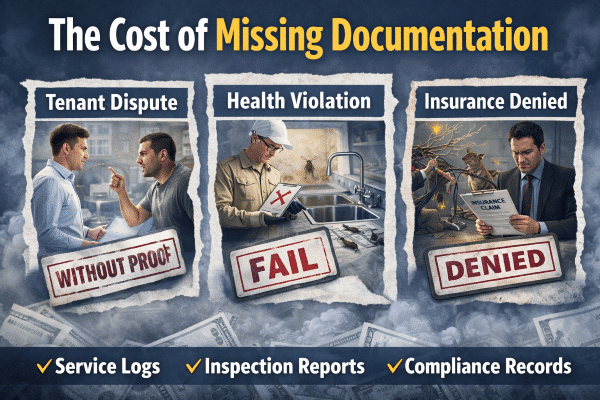
The Cost of Missing Documentation
Most property managers underestimate documentation risk because problems don’t appear immediately.
They appear during inspections, disputes, or lawsuits.
Here’s what typically happens when records are missing:
Scenario 1: Tenant Withholds Rent
Tenant claims infestation → requests proof of treatment → management has none → rent dispute escalates.
Scenario 2: Health Inspection Failure
Inspector asks for service history → no inspection reports → property cited for non-compliance.
Scenario 3: Insurance Claim Denied
Rodent damage occurs → insurer requests maintenance records → lack of pest management documentation voids coverage.
The financial damage isn’t the pests, it’s the paperwork gap.
Professional providers, including Touch Down Pest Control, structure programs around documentation first and treatment second because prevention of liability is often more valuable than elimination of pests alone.
How Organized Documentation Improves Property Value
Consistent pest control documentation doesn’t just avoid problems — it increases asset value.
Investors and buyers review maintenance records during due diligence. A property with documented pest management:
- Sells faster
- Commands higher offers
- Passes inspections easier
- Reduces negotiation deductions
In contrast, undocumented pest history raises immediate red flags.
For HOAs and multi-family complexes, this can impact appraisal value significantly.
Building a Simple Documentation System
You don’t need complicated software, just consistency.
Create a digital folder structure:
Pest Control Records
- Service Logs
- Inspection Reports
- Compliance Documents
- Communication Notices
- Corrective Actions
- Annual Summaries
Keep at least 24 months of records accessible.
Many professional pest control providers maintain online portals where managers can instantly retrieve reports during inspections, which saves enormous stress when authorities arrive unannounced.
People Also Ask (FAQ)
1. How long should property managers keep pest control documentation?
At a minimum, keep two years of records. Many insurers recommend three to five years for liability protection.
2. Do single-family rentals need documentation?
Yes. Even one unit can face legal disputes. Records protect landlords just as much as large complexes.
3. What is the most important pest control document?
Service logs combined with inspection reports. Together, they prove action and prevention.
4. Can a tenant legally request pest control records?
In many regions, yes, especially during disputes or habitability complaints.
5. Is DIY treatment acceptable for documentation purposes?
Usually no. Courts and inspectors often require licensed service verification to validate compliance.